
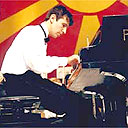
Macedonian pianist Simon Trpceski is only in his early 20s, but he is already attempting some remarkably daunting works. He ended his Wigmore Hall programme with Stravinsky's Three Movements from Petrushka, the composer's sadistically virtuosic transcription of numbers from the orchestral score. Trpceski played the pieces as if they were no more demanding than an elementary technical exercise; yet what was more impressive was the way he depicted the expressive character of each movement. He created a cavalcade of characters in the final Shrovetide Fair, as individual rhythms and dances emerged from the texture. It was as if he were a film director controlling a crowd scene, cutting from one section of the drama to another.
Trpceski found a dazzling range of colours even in Stravinsky's densest piano writing, transforming the piano into a virtual orchestra. He needed the same alchemical skills in Grieg's Holberg Suite and Ravel's Valses Nobles et Sentimentales, both pieces that are more familiar in orchestral versions. The subtlety of his playing meant that the piano was no poor substitute for the orchestra. In fact, he revealed a contrapuntal energy in the fast movements of the Holberg Suite, and found a limpid clarity in Air, the long fourth movement in the sequence. His performance of the Ravel was equally convincing.
But his ability to sculpt large-scale musical structures was best revealed in his performance of Brahms's Variations on a Theme of Schumann. The piece - an elaborate homage to Robert and Clara Schumann, who sponsored Brahms's early career - builds a vast edifice from the simplicity of a Schumann melody. Trpceski showed off the work's compositional and technical brilliance, as the variations veered from extrovert drama to meditation. The piece was composed after Schumann had been admitted to the asylum where he would eventually die. In Trpceski's performance, the final variation had a tragic intensity, as the theme dissolved into a sequence of halting, unconnected fragments.
