
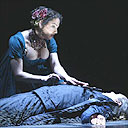
David McVicar's new English National Opera production of Puccini's Tosca is essentially a chilly exercise in erotic transgression and sadomasochistic extremism. It's also an incoherent effort, lacking both the power and integrity of his finest work.
Until now, McVicar has proved among the most clear-minded of directors, capable of prising open a work to reveal its emotional, sexual and political tensions, often with unblinking force. Tosca is an opera on which one might have expected him to shed radical light, yet curiously, its essence eludes him, and in some respects he manages to split the work in two.
At the centre of his concept is Puccini's much discussed emphasis on sadism - his queasy revelling in the spectacle of female suffering and his equation of male sexuality with brutality and power.
McVicar attempts to push the boundaries by suggesting an erotic response on Tosca's part to Scarpia's violence. Taunted by him in church, she recoils, then flings herself into his arms as if wanting some emotional or sexual comfort.
The moment she has murdered him, she fondles his body with sensual relish, then places a lingering kiss on his lips. Such moments sit uneasily both with Puccini's intentions and with McVicar's portrayal elsewhere.
Little in Cheryl Barker's Tosca prepares us for that awkward necrophiliac moment. She turns Tosca into an impulsive hoyden, younger than most, who sweeps barefoot into the church hell-bent on seducing John Hudson's handsomely bullish Cavaradossi, then throws a scandalous scene in public, when she suspects he has been clandestinely meeting the Marchesa Attavanti.
We get little indication of what might attract her to Scarpia, since Peter Coleman-Wright plays him as an unappealing psychopath, with an alarming habit of sniffing his fingers when he touches a woman.
McVicar's insights are reserved for Act II, when he presents us with a telling equation of political tyranny with institutionalised serial killing. Scarpia consigns his victims, Silence-of-the Lambs-like to an underground pit in the floor of Michael Vale's set. The torturer even wears a mask modelled on that worn by Hannibal Lecter.
Musically, things are similarly mixed. The performance is well sung, though poorly conducted. Barker makes a gorgeously sensual noise, her voice sumptuously riding the orchestra and lurching thrillingly over Puccini's wide-ranging lines. Coleman-Wright is her antithesis, expressionistic in utterance, while Hudson is forceful and effortless, though his middle registers occasionally lack power. Conductor Mark Shanahan is often passionless, pacing the score by fits and starts rather than emphasising its cumulative sweep.
· In rep until April 17. Box office: 020-7632 8300.
