
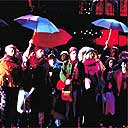
Inner-city squalor and the bourgeois refinement of Glyndebourne are, on the surface, worlds apart, though in David McVicar's production of La Bohème, they converge. This is one of a number of recent stagings that relocates Puccini's masterpiece to a tawdry, urban present in an attempt to strip the work of the sentimental accretions it has acquired over the years. In so doing, McVicar preserves, by and large, the work's emotional force without romanticising the poverty and sickness that eat away the characters' lives.
His Bohemians live in a grubby London flat, surviving on their wits and their idealism. Marcello designs posters protesting against the war with Iraq, splattering George Bush's face with bloody slashes of paint, while Rodolfo taps away at his writing on a cast-off typewriter. The Cafe Momus, where Musetta swans about with the City set, is a poncy wine bar with banks of TV screens relaying broadcasts of naff, middle-class Christmas celebrations. The tragedy derives from the fact that Mimi is incapable of survival in this harsh world. We first see her, emaciated and pale, collapsing in the doorway of the Bohemians' flat. She and Rodolfo split up by the light of dawn as the city empties its rubbish into the streets. Later, she shudders to her death on a mouldy old mattress on the floor.
As a piece of theatre, it packs a punch. Musically, however, its values are less assured. The conductor is Mark Wigglesworth, who matches McVicar's lack of sentiment by turning the score into a conversation piece, propelling it forward with great urgency and refusing to allow the singers any lyrical overindulgence.
The men are fine. Rolando Villazon, singing with wonderful elegance and ease, is a touchingly bookish Rodolfo, first gazing at Mimi over the rims of his spectacles with childlike wonder, excruciating to watch at the end when he is unable to cope with her death. Nathan Gunn, athletic and hunky, is a wonderful Marcello, as handsome vocally as he is physically. The women, however, are not in the same league. Moments of sour tone make Elizabeth Norberg-Schulz's Mimi less than appealing, despite her gamine, waif-like presence. Giuseppina Piunti's Musetta looks sluttishly beautiful and makes a very voluptuous sound. Her intonation, however, is too suspect for comfort. The whole is an uneven effort, though Villazon and Gunn make it worth hearing.
· In rep until July 1. Box office: 01273 813813.
