
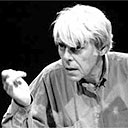
The mark of a great conductor lies in his or her ability to make the familiar seem completely new, so that an audience feels that they are listening for the first time to something they technically know backwards.
This is a rare quality, though one that conductor Frans Bruggen seemingly possesses in spades. His programme for this remarkable concert with the Orchestra of the 18th Century - the period ensemble he founded in 1981 - consisted of Schubert's Unfinished Symphony and Beethoven's Eroica. Both works were challengingly rethought; both roused emotions contrary to anything one expected.
We tend to think of the Unfinished as primarily elegiac and consolatory. Bruggen, however, redefined it as one of the 19th century's great tragic statements - a work that, in its cathartic nobility, rivals Schubert's own Winterreise or the grief of his C major Quintet.
The emotional pattern was one of assertion and collapse, while parallels and contrasts between the symphony's two sections were relentlessly pointed up. The obsessive, low pizzicato strings that drove the first movement later trudged, exhausted, beneath the second movement's opening theme.
The second movement's fading woodwind melody seemed like a response to the crushing of the first movement's second subject by savage chords. Vibrato-less strings and wind conspired to rob this music of any hint of comfort, and endowed it with a sense of bleak alienation throughout. The work will, I suspect, never be quite the same again for anyone who heard this performance.
Bruggen's response to the Eroica was somewhat different - not so much a redefinition of the work as an interpretation that aimed at widening its emotional range without fracturing its expressive unity. The tone was intimate rather than solemn, with the great Funeral March, taken much faster than usual, hinting at private grief and painful memories rather than ritual mourning.
Elsewhere, elation tipped into brief moments of humour, a quality rarely associated with the Eroica. There were passages in the first movement when the triple time acquired a swinging Viennese lilt. The Scherzo had a mercurial wit, while the finale gradually built to a stamping dance of triumph, earthbound and Dionysiac. Some might find it idiosyncratic, but the end result kept you on the edge of your seat from beginning to end.
