
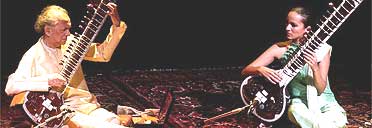
It was strange to be in the largely deserted City of London on a Sunday afternoon to listen to a concert, but for Indian classical music, and its greatest exponent Ravi Shankar, there's a time and a place for everything. "Friends," he said, "you are first going to hear two afternoon ragas." He later added that, given the weather, he should have chosen ragas for the rainy season.
It was just after two in the afternoon and the Barbican, specially scented for the event with what smelled like rose petals, was packed. A small platform, covered in carpets and low cushions, had been constructed on stage, with two tabla players sitting cross-legged on the front corners, and two of Ravi's students, who would provide the tinkling wash of sound from the tamburas, sitting at the back.
They were joined by a glamorous 21-year-old with black hair, bright red trousers and pink blouse, who has the distinction of being the only sitar player in the world to have been trained exclusively by Ravi Shankar, her father. Finally, Anoushka's dad appeared, dressed in white. He showed the frailty of his 83 years as he approached the platform, but once he picked up his sitar, to a standing ovation, his age didn't matter. For two hours, he gave a blistering demonstration of the technical skill, dazzling speed, range and intensity that have made him a hero for musicians as varied as Yehudi Menuhin, John Coltrane and George Harrison.
When Anoushka and her father played together at Womad six years ago, she was still a talented novice. Now her playing and confidence have improved enormously, to his obvious delight. The finest, most exhilarating moments came when they swapped solos, musical themes and often rapid-fire passages of improvisation between the two of them. He may have been the leader, and still the more nimble-fingered, but she never lagged behind, and the better she played the more Ravi was inspired to show off even more of his extraordinary technique.
Despite his links with western pop (now further strengthened by the success of his elder daughter, Norah Jones), there were no concessions to non-Indian classical styles here, and none were needed. He stuck to the ragas, explaining their rhythmic structure and the stories behind them ("This was a favourite for a Maharaja taking an afternoon siesta").
Each began with a slow, stately opening, in which he might bend the notes like a blues guitarist, then gradually built up to those wild improvisational duets, or to furious interplay with tabla players Bikram Ghosh and Tanmoy Bose, unleashed at the end for a frantic drum display. An exhilarating Sunday afternoon.
