
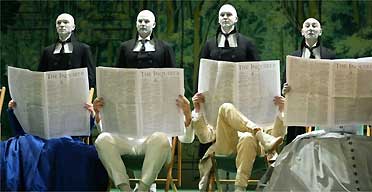
First performed in 1738, Handel's Xerxes is a bleak comedy about the nature of erotic manipulation and emotional control. It deals with the sexual shenanigans of royalty and questions the nature of the relationship between power and desire. Xerxes himself is one of Handel's most disturbing creations: a man who believes that the emotions of others can be turned on and off at will and that he can despotically dictate their progress.
Though the plot moves towards a supposedly happy ending, it suspends genuine resolution. Bullying and deception in the corridors of power remain disquietingly unchecked. Xerxes, who has dumped his mistress Amastre in order to pursue Romilda, the fiancee of his brother Arsamene, gets his comeuppance but remains locked in self-delusion. Atalanta, Romilda's devious sister, who wants Arsamene herself, worms her way out of the plots she has hatched.
This semi-staged performance, featuring William Christie and Les Arts Florissants, fails to examine fully the work's implications. Christie, at his best in French neoclassical tragedy, is less assured when it comes to Handel's sprawling dramaturgy and occasionally misjudges the opera's tone. His conducting is elegant, refined and polite. The outer edges of eroticism and darkness are absent. Sensuality is transformed into decorous sensuousness and Handel's savage irony is at times blunted.
There are, however, compensations in the casting. Anne Sofie von Otter is tremendous in the title role, preening and swaggering like some monstrous bird of prey and flinging out coloratura with a combination of hauteur, venom and glee. As Atalanta, Sandrine Piau wheedles and seduces with stratospheric high notes of dangerous beauty, while counter-tenor Lawrence Zazzo is thrilling as Arsamene.
Less successful are Elisabeth Norberg-Schulz, overly coy as Romilda, and Silvia Tro Santafe's Amastre, revealing a tangy alto of considerable power, though monochrome in her delineation of a character that veers towards tragedy and whose inner agony forms a bitter judgment on the opera's cruel world.
