
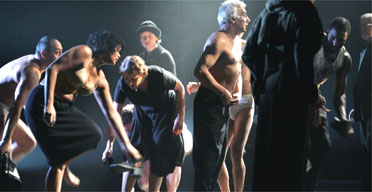
Rather than a new production of one of Tippett's five authentic operas for the centenary, English National Opera has opted to present the oratorio A Child of Our Time. Premiered in 1944, it was the work that established Tippett as a distinctive voice in British music, and remains one of his most frequently performed scores, yet as far as I know it has never been staged before. Whether it lends itself to such a presentation is another matter.
The problem is that only the second of the three parts of A Child of Our Time really has a dramatic spine running through it. The rest is commentary and meditation about the events in 1938 that prompted Tippett to compose the work, when 17-year-old Herschel Grynspan, a Polish Jew, shot a German diplomat in Paris in protest at the persecution of his family in Germany; the Nazis took their revenge in the pogrom of the infamous Kristallnacht. Tippett saw Grynspan as a scapegoat and made him the protagonist of his modern passion, for which he wrote his own text, heavily larded with Jungian symbolism.
Director Jonathan Kent works hard to cut through the verbiage to provide the piece with the drama it needs. Paul Brown's set is minimalist, a space into which other elements - forests of knives, lights or large pebbles descending from the flies, a leafless tree bursting into flame over Grynspan's grave in the final moments - are added sparingly, often sacramentally. With the chorus - on stage throughout - precisely choreographed and dressed in sombre, dowdy clothes, Kent's aim clearly was to universalise the work as a parable of oppression for the 20th century, with a troupe of actors providing the extra narrative layer.
But it never gels, nor becomes anything more than earnestly sincere; at times it is positively sanctimonious. The imagery is sometimes hard to fathom, though that is no fault of the performers. Martyn Brabbins's account of the score is grippingly urgent and muscular; the singing of the ENO chorus, so central to the work, is full-blooded, and the four soloists (Susan Gritton, Sara Fulgoni, Timothy Robinson, Brindley Sherratt) are mostly first-rate too, even if their words (mercifully perhaps) are not always clear. The best moment - the chorus Steal Away, the first spiritual of the five that are dotted throughout the work, with Gritton's gleaming soprano soaring above - is transcendent, but significantly it makes its effect without any theatrical help.
· Repeated on Friday. Box office: 020-7632 8300.
