
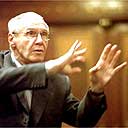
Gyorgy Kurtag's music is larded with acknowledgments of the past, of the great tradition that he has supported as a teacher and coach. Sometimes the references are more or less explicit quotations; in other pieces, the connections are more elliptical.
The 1988... Quasi Una Fantasia... Op 27 No 1 is a miniature piano concerto in all but name. Op 27 No 2 (Double Concerto), as he titles it, pits solo piano and cello against two groups of instruments arrayed around the hall. Both have a relationship with the two piano sonatas of Beethoven's Op 27 (the second of them the Moonlight), but there are no explicit musical connections, and what links them in Kurtag's mind is some intangible sense of structure or expressive purpose.
These exceptional scores formed the core of the last of the South Bank's concerts in its Kurtag series. Here, the London Sinfonietta and the Manson Ensemble of the Royal Academy of Music (which is also celebrating Kurtag) were brought together under the conductor Reinbert de Leeuw. Zoltan Kocsis was the soloist in both Kurtag works (earlier in the evening he had also paired Beethoven's two Op 27 sonatas in a short recital); in the Double Concerto he was joined by cellist Miklos Perenyi.
The pieces were written for Kocsis (Kurtag has been working on another piano concerto for him since the 1980s) and it is easy to see why. The pianist possesses the same gift as the composer for defining an expressive world in a single phrase. The slowly descending piano scale that opens... Quasi Una Fantasia... was invested with such a range of touch and colour, it seemed to open up the huge vistas that the rest of the work compresses so miraculously into 10 minutes. The Double Concerto is larger-scale, and if anything even more remarkable - by turns physically assertive, wispily elegiac and ending in bleak acceptance.
The rest of this perfectly conceived all-Hungarian programme brought sparky performances of Ligeti's Melodien and his trumpet showpiece, Mysteries of the Macabre, with John Wallace as the irrepressible soloist. Students from the RAM also gave a very fine account of Bartok's Sonata for Two Pianos and Percussion. If it was slightly underpowered, that was the acoustic's fault, not the players'.
