
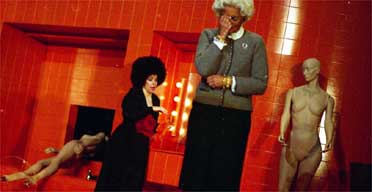
The Bitter Tears of Petra von Kant
Coliseum, London WC2
Don Carlos
Millennium Centre, Cardiff
Maskarade
Covent Garden, London WC2
The world premiere of a new opera in English, based on one of the seminal films of the Seventies, is a major coup for English National Opera, the kind it should pride itself on pulling off. Conductor, director, designer and soloists are all perfectly chosen and deliver in high style. So it's a pity, to say the least, about the music, which ultimately turns out to be the sole undoing of The Bitter Tears of Petra von Kant.
Irish composer Gerald Barry has long been a foe of the human voice, setting it so high and fast that few words can be heard, drowning it in the brassy cacophony which is his trademark. For chamber or orchestral works, Barry may be one of the most original and distinctive voices around; when it comes to opera, he needs to rethink his style more radically than he seems able to hear.
For this production, the first of its new season, ENO has felt obliged to bring forward its controversial plans for English surtitles above opera in English, an in-house admission that little of the libretto (a word-for-word translation of Fassbinder's original play) can be heard through the remorseless fortissimo of Barry's score, an unremitting series of sliding scales which bear no discernible relation to the unfolding drama or the emotions the characters are trying to convey.
Even though the fine house orchestra lies buried beneath a catwalk, a stroke of genius by designer Ultz, who also maximises the width of the great Coliseum stage, the constant bombardment of repetitive noise, expertly conducted by Andre de Ridder, is a real pleasure to escape after two interminable hours.
This is the forlorn saga of paranoid Petra's unrequited lesbian lust for a ditzy but ambitious model, who consents to a leg-over only to get a leg up. Dumped Petra's angst then damages all within reach as surely as her fragile psyche and our equally fragile eardrums.
The taxing title role is superbly sung by Stephanie Friede, with fine support from Rebecca von Lipinski as her cynical lover, Kathryn Harries as her tut-tutting mother, Barbara Hannigan as her put-upon daughter and Susan Bickley as her bitchy friend. Richard Jones's pacy staging uses stuffed animals and constant changes of weird costumes to keep the action moving as fast as Barry's relentless score.
But when an opera is stolen by its only mute character, the long-suffering secretary brilliantly acted by soprano Linda Kitchen, something has gone seriously wrong. All five other characters are hopelessly mired in caricature. It is impossible to sympathise, let alone identify, with any of them, least of all petulant Petra herself, whose surname might as well be von Rant. 'I saw myself in her,' said Barry in a pre-opera interview. I rest my case.
It has taken Welsh National Opera 10 years to mount its epic production of Verdi's Don Carlos and it has been well worth the wait. Connoisseurs of this mighty piece may find details to question in this 'original' (with variations) five-act version, conducted with passionate conviction by Carlo Rizzi; but its three-and-a-half hours of music rarely lose pace or grandeur.
Schiller's play explores the grim consequences of a regal father's hijacking for political purposes of his son's intended bride. Amid all the menace of the Inquisition, symbolised by the onstage torching of some pesky heretics, the enduring love of the young couple can bring them only to sticky ends. Humanity, in other words, is always the loser in royal power games.
Stage director John Caird proves a shrewd choice to realise the opera's intense theatricality, using many a crucifix to convey its sinister religious background and a variety of period costumes to render this monumental piece potently timeless. Characters in vaguely Spanish gear of various eras look surprisingly at home alongside power-crazed clerics in antique garb and slouching, leather-jacketed bodyguards in modern police-state shades.
As the hijacked bride Elisabeth, Nuccia Focile proves the evening's most authentic Verdian, singing with effortless grace and poise. Paul Charles Clarke's adequately sung Don Carlos seems a tad gauche to die for; there's mettle more attractive in Scott Hendricks as his dashing friend, Rodrigue. The only weak link is Andrea Silvestrelli's Philippe , who looks the part but sings it over-forcefully, while failing to convey the human frailty and self-doubt beneath his regal trappings.
But this is a noble version of this wonderful work, all too rarely seen on this Shakespearean scale, enough to give hereditary monarchy a bad name as it tours from Edinburgh next month and then via Llandudno, Oxford, Birmingham, Bristol and Southampton to Liverpool in December.
David Pountney's extra-vagant staging of Nielsen's Maskarade has arrived at Covent Garden from Bregenz with a new cast and surtitles conveying verbatim highlights of his own, often arch translation.
'The flames are roaring/Our hearts are soaring': even Pountney himself feels the need to send up such 'flummery' (another of his own words) by having stooges mock it with gypsy violins. There is an air of desperation about the whole gorgeous enterprise, as lavish sets (Johan Engels), sumptuous costumes (Marie-Jeanne Lecca), garish lighting (Wolfgang Goebbel), stylish choreography (Renato Zanella) and every trick from the ingenious Pountney's magic box cannot conceal or, in the end, much perk up the plodding paucity of the piece.
Into this limp saga of mistaken identity, built around a Danish Figaro, Pountney injects everything he can think of, from flying angels and clocks to Elvis, Marilyn and Madonna performing star turns at an 18th-century masked ball. But he fights a losing battle, for all the well-sung if hyperbolic performances of Michael Schade as the young lover, Kyle Ketelsen as his servant and Brindley Sherratt as his crusty father.
If this is Enlightenment thinking, as asserted in the programme, it's more school of Stanley Baxter than Schopenhauer. The score, too, is as slight as jaunty, for all the expert efforts of Michael Schonwandt to keep a spring in its step. If Nielsen subsequently decided to stick to symphonies, who are we to demur?
