
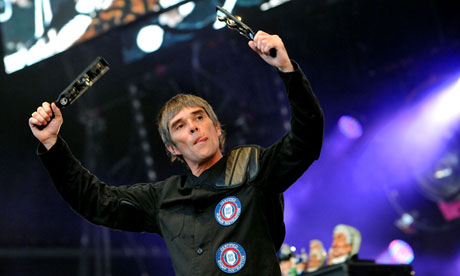
It is now neither the second coming of the Stone Roses, nor the third, but arguably the fourth. The band who split up so bitterly in the wake of their second album, Second Coming, in 1996 reunited for a series of shows last year, an event chronicled by the Shane Meadows documentary Made of Stone, released in cinemas last week.
To coincide with the film's release, the Madchester group also played two huge shows in Finsbury Park in north London on Friday and Saturday, just down the road from Alexandra Palace, scene of their most celebrated gig in the capital in November 1989.
It's nothing novel for bands to reform, although guitarist John Squire did create an artwork inscribed with the message "I have no desire whatsoever to desecrate the grave of seminal Manchester pop group the Stone Roses" as recently as 2009, so in this instance it did seem exceptionally unlikely.
But few groups have ever inspired as much affection as the Roses, as became evident at Finsbury Park on Friday, where it felt as if every one of the 7,000 fans who'd descended in their flares on Ally Pally almost a quarter of a century earlier had returned to pay homage – even if the flares wouldn't fit any more.
One of them was my old friend Dan, whose decision as a teenager to go to college in Manchester was in no small part encouraged by the blossoming music scene there: no longer so much the Smiths, but the acts you could hear at the Hacienda like A Guy Called Gerald, plus Happy Mondays and the Roses and lesser lights such as Inspiral Carpets and Paris Angels.
On Friday, he reminded me that the first time he ever came to my house it was because I was the only person he knew who had a recording (VHS, I think, not Betamax) of the Stone Roses' infamous first-ever TV appearance on the BBC2 arts programme The Late Show, when the power cut out and Ian Brown shouted "Amateurs! Amateurs!" behind Tracey MacLeod.
Events like that – even the band's appearance in court after splattering paint all over the offices of their former record company – helped to create a sense of mystique: this band was different, not one cut from the same cloth as their shy and retiring indie peers. For anyone not old enough to remember the era, it might sound funny, but before the Roses, guitar bands had given up on ambition.
In interviews – and they were impressively awkward interviewees (in the Meadows film, there's a particularly excruciating example) – Ian Brown said things like: "I think we could be the biggest band ever."
It's in that sense that the band paved the way for the ambitions of another Mancunian band, Oasis, but the Roses imploded before really making it big first time around. The band never had a British No 1 and, in the United States especially, the Madchester hooplah was never repeated, a point that was brought home earlier this year when the crowd watching the Roses' headline set at the Coachella festival in California was reported to look embarrassingly sparse.
But simple headlines miss a point: with the Stone Roses, there was always an aura, so even if that famous Ally Pally gig was actually rather unimpressive – Dan remembers the sound bouncing around the venue and a palpable sense of letdown – it's still thought of as something special.
Likewise with Spike Island: the gig at an old toxic wasteground in Cheshire in the summer of 1990 that is thought of now as the Madchester scene's own Woodstock, even though reviews at the time were decidedly mixed. It has now inspired a new film called Spike Island, a coming-of-age drama directed by Mat Whitecross, that charts the journey of five teenagers to the gig in Widnes. It follows on the heels of the Shane Meadows documentary into cinemas later this month.
It was partly the Stone Roses' attitude, and it was partly the way they looked. It was also because they brought guitar music together with the burgeoning acid house scene, and a generation was getting a taste for a new kind of drug, ecstasy.
But no doubt, too, what brought not just 7,000 or more old fans to Finsbury Park on Friday but a further 33,000 was a sense of unfinished business. The breakup of the Stone Roses culminated in another gig that has achieved mythic status for all the wrong reasons: the band's headlining set at the Reading festival in 1996, after John Squire and Reni, the drummer, had quit and Brown's vocals were flatter than the flattest of caps.
In Shane Meadows's fan letter of a documentary film, there is a scene of the band gathered before their press conference to announce their comeback in 2011, and Mani, the bassist, says friends who have heard the rumours are already asking him for guestlist tickets for any shows.
In the end, the three gigs the band announced for Heaton Park in Manchester sold out in 68 minutes and netted £11m. If the persistence of the touts was anything to go by outside Finsbury Park on Friday, the demand for the two shows this weekend was equally impressive.
Reni has said that he quit the band the first time around because "I didn't see any future in it other than a treadmill trading on the past". The cynical might say these reunion shows are exactly that – an empty exercise in nostalgia conceived to generate as much revenue for the ageing group as possible.
But counter that with Squire's claim that this reunion is the result of a need to fix a friendship, and even though Brown did often lapse wildly out of tune on Friday night (as my friend, Dan, kept reminding me), the euphoria in the crowd as the evening came to an end with I Am the Resurrection was palpable.
