
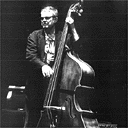
If all you knew about Charlie Haden had come from a book, his Barbican performance with Quartet West might have come as a surprise. The bassist was one of the first partners of the then highly controversial Ornette Coleman; and, as a dedicated socialist as well as a gifted bandleader, he led an ensemble of free-jazz players interpreting Spanish Civil War freedom songs during the Vietnam era of the early 1970s. But if he has an iconoclast's CV, Haden in later years has become a more tranquil man, on stage at any rate.
He is a superb double-bassist with a rounded, bell-like tone and a wilful way of pacing his phrasing to stretch the tempo boldly out of shape, and he still improvises like a man in an absorbed and absorbing world of his own. But Haden's longstanding group Quartet West is far more reflective of the 1950s west coast cool-jazz sound, and of a Los Angeles ambiance generally. Its music conjures up images of bars in black and white, Bogart and Bacall, but the lazy and luxurious manner of the band's approach disguises considerable intensity and improvising skill.
As a complete contrast, the show was launched by the piano trio of Uri Caine, the man probably better known here for his jazz reworkings of Mahler and Bach. But Caine's set - a breathtaking display of piano and ensemble virtuosity - was based on standards and jazz classics by Thelonious Monk, Miles Davis and others, with Davis's Nefertiti a standout. A remarkable collective account of Round Midnight crackled with percussive chords, sudden scuttling runs and scampering basslines. In an era of fine jazz piano trios, Caine's belongs up there with the best and most enterprising of them.
Charlie Haden Quartet West played the second half with the retiring leader in shadow at the back of the stage. At first the softly winding themes suggested the Gerry Mulligan/Chet Baker ensemble of the 1950s (Larence Marable's delicate drumming recalled the percussionless rhythm of that group), but saxophonist Ernie Watts revealed more of his remarkable distillation of cool-sax and John Coltrane-multiphonics as the show developed. All four played fine solos (Haden's, as ever, sounding like low-register songs), but Watts and pianist Alan Broadbent were frequently dazzling, with the latter's mix of stride, arpeggiated classicisms, blues and postbop devastating in an unaccompanied passage late in the set. Much of the music was light and nostalgic, but Ornette Coleman's Lonely Woman received a spine-tingling account, particularly from Haden's reverberating bass and Watts's anguished tenor.
