
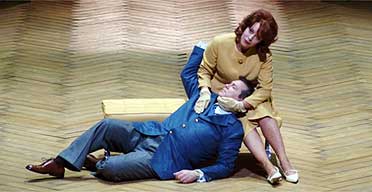
Christoph Marthaler's new production relocates Wagner's masterpiece to an unidentified central European city, a decade or so after the second world war. This has predictably caused ructions in Germany where the Swiss director's work is the subject of ongoing controversy. While the trans- position reminds us that the opera does, indeed, take place some years after a protracted military conflict, Marthaler comes close to overstating his case. What for Wagner is a point of detail in an internalised psychodrama becomes instead a central element.
The production is compounded of insight and banality in equal measure. Marthaler's primary aim is to drive Brechtian alienation effects into the work, opening a gulf between its metaphysics and its narrative reality. What we watch is an occasionally squalid tale of bourgeois adultery.
The lovers - Robert Dean Smith and Nina Stemme - first admit their feelings in what looks like a ferry lounge area, and meet for their secret tryst in the lobby of a dilapidated hotel. Politics heave into view, however, when they are discovered by Kwangchul Youn's presidential Marke and Alexander Marco-Buhrmester's Melot, a thug left over from some prewar totalitarian regime.
Accusations that Marthaler has ignored the work's metaphysics are unfounded, though he handles them unsubtly. Neon lights swirl into configurations, flickering on and off whenever the text's day-night imagery requires. After Tristan has shuddered to death in a hospital bed, Isolde sings the Liebestod wrapping herself in his soiled sheets, before finally laying herself out as if on a mortuary slab.
The overall effect, however, is one of cool dispassion, reinforced at times by the musical interpretation. Japanese conductor Eiji Oue has seemingly taken on board Strauss's dictum that Tristan is "the most beautiful bel canto opera", and, Andreas Schmidt's woefully imprecise Kurwenal aside, singing and playing are consistently ravishing.
Yet beauty is never quite enough in Tristan. Smith, in particular, is staggering, but neither he nor Stemme are prepared to go to the requisite outer edges of erotic mania, nor does Oue seem prepared to take them there. The whole thing bravely attempts to shed new light on one of the most elusive of operas, but the end result is both mesmeric and maddening.
· Until August 26. Box office: 00 49 921 78780.
