
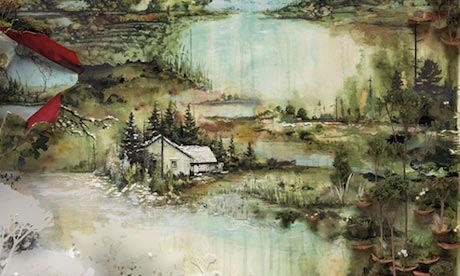
If there was reason to doubt Justin Vernon's staying power three years ago it was the seductive neatness of his debut album's backstory: the beardy midwesterner who disappeared into the snowy woods to nurse a broken heart. It suggested fluke brilliance and a future in the Americana undergrowth, where warm reviews mingle with modest sales. But the future sounded more intriguing after 2009's Blood Bank EP, whose eerie Auto-Tuned a cappella Woods caught the ear of Kanye West – and made Vernon the rapper's most unlikely favourite since Chris Martin.
Yet West's endorsement made a kind of sense. On his second album Vernon became, like Peter Gabriel and Kate Bush in the 80s, as much a producer as a singer-songwriter. First-time listeners zeroed in on final track Beth/Rest, either smiling or frowning at the influence of melancholy 80s smoothies such as Bruce Hornsby and Phil Collins. But Vernon's new sound – bright yet blurry, like winter sunlight shining through mist – is no pastiche. It was as if he had extrapolated the elusive beauty of his keening voice and puzzling lyrics into the arrangements themselves, weaving a ravishing tapestry of folk, jazz, ambient, electronica and MOR.
Each song title is a place name, real or imagined, and the album unfolds as a dreamlike travelogue, winding a path down highways, through forests, over lakes. This exquisite mood music could be mistaken for mere background prettiness were it not for the frequent bursts of revelation: the climactic, brass-led ascent of Perth, or Vernon's awed epiphany in Holocene: "I can see for miles, miles, miles …" Rich and expansive without being the least bit grandiose, it won myriad fans (and four Grammy nominations) by stealth: a quiet record that ended up making a great deal of noise.
