
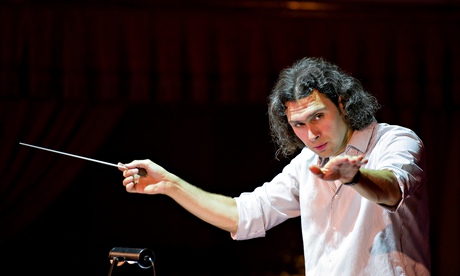
The latest instalment of Vladimir Jurowski’s Rachmaninov retrospective with the London Phil, this disquieting concert juxtaposed the 1906 one-act opera The Miserly Knight with a digest – Jurowski’s own – of extracts from Wagner’s Das Rheingold. Both works deal with the loveless nature of greed; hearing them together was a reminder of just how much Rachmaninov’s obsessive Baron owes to Wagner’s Alberich.
The evening also, however, raised the complex issue of antisemitism in the work of both composers. The Miserly Knight contains a portrait of a Jewish moneylender that is virulently racist and ultimately prompts questions about the opera’s acceptability. Placing it next to Wagner, meanwhile, reminded us of the ongoing, and to some extent still unresolved debate as to just how far the prejudice – blatant in his life and writings – colours, or is encoded in, the latter’s operatic output as a whole.
Jurowski conducted The Miserly Knight at Glyndebourne and the Proms in 2004, and this semi-staging reunited him with the production’s original Baron, Sergei Leiferkus, and its director, Annabel Arden. Leiferkus’s powerhouse singing and Jurowski’s insistent conducting left us in no doubt as to the baleful nature of the score, but couldn’t, even so, disguise the static quality that is another of its problems.
The Rheingold extracts were hit and miss. Jurowski gave us the first scene complete, with Leiferkus as an unusually empathetic Alberich, and Natalya Romaniw, Rowan Hellier and Harriet Williams the very classy trio of Rhinemaidens. That should have sufficed, for what followed was an awkward sequence of orchestral gobbets, leading to the Entry of the Gods into Valhalla, sung by other members of The Miserly Knight cast, none of whom are Wagnerians. You couldn’t really tell what language Vsevolod Grivnov’s Loge was actually singing in. Maxim Mikhailov was the underpowered Wotan.
