
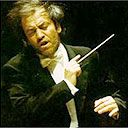
Valery Gergiev and Kirov Opera sometimes seem to be engaged on a never-ending tour to rival Bob Dylan's, and the purpose of their flying visit to London this week was originally intended to be a concert performance of Glinka's rarely heard epic, A Life for the Tsar.
But even the fabled strength-in-depth of the company's vocal resources has its limits, it seems; when the two singers who were to take the main roles in the Glinka both fell ill, there were no replacements to be found readily and the performance had to be cancelled just two days beforehand.
Instead, Gergiev quickly marshalled a replacement - an account of Eugene Onegin that would have distinguished any opera company in the world. Anyone who felt short-changed to get Tchaikovsky singing and playing of this standard instead of the Glinka must be an operatic trainspotter of the most determined kind.
Of course any company that can rustle up at such short notice a singer of Mikhail Kit's class, for instance, to sing the role of Prince Gremin with such unaffected eloquence really does have a head start in a performance like this.
But the cast was by no means made up entirely of old Kirov hands. Gergiev is bringing on a new generation of singers to continue the St Petersburg tradition, and Vladimir Moroz and Irina Mataeva, Ekaterina Semenchuk and Daniil Shtoda made for a genuinely youthful quartet of principals.
Of those only Shtoda's performance disappointed; there were some beautiful sounds in his account of Lensky's second-act aria, but not much power or real vocal authority elsewhere, and in his exchanges first with Semenchuk's Olga (a cool, never flirty performance, but one predicated on wonderfully honeyed tone) and then with Moroz's Onegin (detached to begin with, but gradually building in passion and involvement, just as the character should) he was consistently outgunned.
But Mataeva's Tatyana promises to become one of the great interpretations. Whether in the almost conversational, self-communing way in which she began the letter scene, and only gradually gave in to her own bursting emotions, or the noble restraint with which she rebuffed Onegin in the last act, this was a performer already inhabiting the role completely.
Gergiev generated a slow-burning intensity to underpin these first-rate soloists and to chart an unswerving course through the opera's pitiless dissection of the miseries heaped on those whose lives intersect at the wrong moments.
The Kirov Orchestra made every instrumental detail count; the Chorus was vivid and impassioned when required. They, like everybody involved in the performance, have lived with this opera all their professional careers, and that really makes a difference.
