
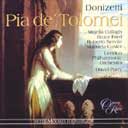
"Give me love - but let it be violent love," Donizetti once told one of his librettists, and few operatic composers since have dwelt with quite such insistence on the often savage fallout from irrational passion. Pia de'Tolomei, first performed in 1837, ranks among his more disquieting works.
Based on a section of Dante's Purgatorio, the opera inhabits the kind of extreme territory we usually associate with Jacobean drama. Believing his wife Pia to be unfaithful, Nello, a Siennese nobleman, has her imprisoned in a tower in the middle of a malarial swamp. When the disease fails to kill her, he has her poisoned, only to discover that the man who has been meeting her in secret is not a lover, but her brother, Ruggero, Nello's enemy in the civil war sweeping Italy. The accusations against Pia, meanwhile, turn out to be the work of one Ghino, an embittered malcontent who could have strayed from the plays of Webster.
Donizetti's response to this ghastly material is often unnerving, though the opera has its flaws. The brash heroics of Ruggero's music can't quite disguise the fact that his character is something of a cipher and remains undeveloped. A bigger stumbling block for some is Donizetti's need to introduce each protagonist with a show-stopping aria, which leads to an over-protracted exposition.
Once Ghino has poured his poison into Nello's ear, however, the opera unfolds with a ratchet-like intensity. Pia gets one of Donizetti's most upsetting mad scenes as malarial fever erodes her mind. Best of all, perhaps, is the extended scene in which Pia finally effects Ghino's moral redemption to music that so closely resembles the great duet for Violetta and Germont in La Traviata that one is forced to conclude Verdi took it as his model.
The opera languished in comparative obscurity until Opera Rara unearthed it in concert last year. That was a great occasion, and one wishes, in some respects, they had taped it live, since their studio version doesn't generate the same intensity. David Parry's conducting captures the work's nervy atmosphere, but Bruce Ford's Ghino sounds too effortful, and Roberto Servile's Nello too graceless for comfort.
The women fare better. Manuela Custer is the fire-breathing Ruggero. Majella Cullagh's Pia is remarkable - technically exacting, and remorselessly exposing the woman's physical, moral and emotional hell. Yet even here you get little sense of her voice's thrilling ability to soar over an orchestra. The set includes an appendix of variants that Donizetti wrote for the score after its premiere, and the accompanying material is impressively scholarly. As always with Opera Rara, great care has gone into the proceedings - though it can't quite make up for the absence of the visceral passion the work demands.
