
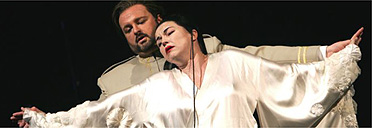
Less than six months after it opened, Anthony Minghella's English National Opera production of Puccini's Madam Butterfly is receiving its first revival. It caused considerable controversy when it was new, and it remains problematic - largely because it ducks most of the issues raised by this most disquieting of operas.
Minghella, mindful perhaps of the fact that this is a co-production with New York's Metropolitan Opera, plays down the work's emphasis on the proprietorial attitudes fostered by US imperialism. Gwyn Hughes Jones's Pinkerton is a cad, and something of a slob, but there's little to link him with the US, and he could be any westerner bent on sexual tourism in the far east. Butterfly's extreme youth, meanwhile, and the fact that she is the victim not only of sexual exploitation but also of squalid monetary exchanges, causes initial flurries of alarm that soon evaporate into insubstantiality.
Elsewhere, Minghella drags in elements of oriental theatre that sit uneasily with the work's naturalism. Japanese Bunraku puppets are used not only to represent Butterfly's son, but also two of her servants and, at one point, her own fantasy alter ego. We rapidly get the point that Butterfly is an innocent in a world of manipulation, although the puppetry also becomes an alienating effect, detracting from the drama. Puccini deals in soul-shattering loneliness. Minghella seems either unable or unwilling to confront the opera's emphasis on human isolation.
The whole thing looks glossily safe, and it's up to the singers to inject the requisite sense of emotional and social danger. There's a new Butterfly in the form of Janice Watson. Wide-eyed and beautiful, she suggests both the girl's naivety and the deep reserves of feeling that drive her on. There's a touch of metal beneath the silky tone. Her body shakes and twists with delight and pain. It's a fine performance, as is David Kempster's Sharpless. Singing with an apology for a cold, he sounded a bit gruff, though this is a remarkably complex portrait of a man whose moral awareness can find no expression in action.
Hughes Jones, also singing with an apology, is suitably vapid, if occasionally inelegant. The conductor, David Parry, is hard-edged, unyielding and often dispassionate, although he brings an element of queasy eroticism into the act one love duet. The evening belongs, however, to Watson and Kempster, who inject a considerable emotional charge into a production that could so easily become bland.
· In rep until May 31. Box office: 0870 145 0200.
