"Opera in ecclesiastical vestments," was how one critic described Verdi's Requiem at its debut in 1874 and, from then on, the debate has raged as to whether the work is genuinely sacred, or primarily characterised by irreligious theatricality. For some, the various arguments can seem specious: the Requiem is, after all, an acknowledged masterpiece, which arouses powerful emotions, so why worry about its ideological probity? For others, taking a stand on its essential nature is all-important, particularly when it comes to interpretation in performance.
The issue is immeasurably complicated by Verdi's own ideological stance. An agnostic, he distrusted organised religion, repeatedly portraying it as a morally corrupt, oppressive force in his operas. As an expression of personal belief, the Requiem is consequently riddled with ambiguities, and it is possible to see its view of the divine as conflicted. God is alternately evoked as infinitely merciful (the Introit and Lux Aeterna), terrifying judge (the Dies Irae) and as the architect of the myriad beauties of creation (the Sanctus). Verdi ends, however, not with the finality of "Amen", but with "Libera Me" ("Release me") endlessly reiterated in a void. God is suddenly absent. It's one of the most unnerving moments in all music.
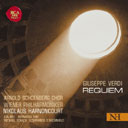
Nikolaus Harnoncourt's new recording is, in some respects, a radical attempt to find answers to both the controversies that surround it and the ambivalences it contains. He demands, first and foremost, that we divorce it from any concept of the operatic and approach the Requiem solely as a setting of a liturgical text with ritual associations. The results are startling, though some may find them strange. Using David Rosen's critical edition, Harnoncourt is zealously scrupulous in his observance of dynamics and phrasing. The choir is smaller than usual and the performance's overall impact derives as much from the Vienna Philharmonic's astonishing playing as it does from the singing. The soloists are instructed to sing without portamento and to avoid self-dramatisation, with the result that they sound like hieratic acolytes officiating at a sacred rite.
Harnoncourt then shifts the work's emphasis away from the traditional. The great moments are the Introit, which slides imperceptibly out of infinity into sound, and the Offertorium, in which time genuinely seems to stand still. Most controversially, the Dies Irae and its subsequent repetitions are taken slower than usual, suggesting ritual majesty rather than explosive terror. The whole thing has a remarkable, primarily devotional unity of mood. It's a fine achievement, though the classic EMI recordings by De Sabata and Giulini both hold terror and compassion in finer balance.
