
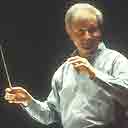
From the opening crack of a unison hand-clap, the London Sinfonietta's performance of Wolfgang Rihm's Jagden und Formen (Hunting and Forming) was propelled on a 50-minute dash of unstoppable energy. Conducted by George Benjamin, this was the first London performance of one of the most ambitious pieces of recent years by one of contemporary music's most important figures.
Jagden und Formen, composed between 1995 and 2001, is a fascinating summation of Rihm's style: a complex confrontation between the Germanic tradition and the achievements of modernism. The lightning speed of the piece does not let up for a second, and it requires an enormous feat of stamina and concentration from each of the 24 players. The musicians take turns to lead the ensemble on this violent, hurtling chase. It begins with a vibrant violin duo, followed by tortuous solos for cor anglais and viola, and a stratospheric melodic line for solo trombone.
The Sinfonietta's performance had us glued to the edges of our seats, flinging us from one musical extreme to another. For all its vast scale, the piece never assumes any recognisable structure: it chases and hunts itself, its own form, throughout the 50 minutes. But Benjamin's conducting made this experience of thwarted expectation keenly pleasurable, and he shaped the performance superbly.
At the end of the piece, there was an unmistakable climax, as a chorale-like line in the wind and brass was overlaid by frenetic counterpoint in the other parts. From the summit of this peroration, it was possible to survey the immense peaks and troughs described by the structure of the whole piece, as if its form had been suddenly revealed. Yet the final sounds were of instability and fragmentation, as a quiet, hollow drumbeat carried this endless hunt into another dimension.
Benjamin paired Jagden und Formen with choral music by French composer Pascal Dusapin, performed by the BBC Singers. There could have been no greater musical contrast. Performing three separate works as a continuous cycle, Benjamin revealed the subtleties of Dusapin's idiom. Setting texts by Meister Eckhardt and excerpts from the Requiem, the composer achieves a delicate balance between meditative calm and expressive intensity.
In Dona Eis, the last section of this composite work, the choir were joined by seven wind players, and the music exploded with grand, ritualistic intensity. Yet, for all its power, this refined, reflective music was obscured by the onslaught of Rihm's ceaseless energy and invention.
