
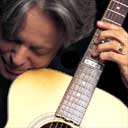
Though he seems to be in little danger of becoming a household name over here, Tommy Emmanuel is a showbiz legend in his native Australia (where he was a child prodigy in the 1960s), and is a good enough guitarist to have prompted country music guru Chet Atkins to describe him as "probably the greatest finger-picker in the world today". During this sprawling two-hours-plus show, Emmanuel breezed through a broad swathe of material in an assortment of styles as nonchalantly as if he was sprawled in an armchair reading the racing results, though there were convincing grounds for accusations of style over substance.
Emmanuel began a successful career as a session-man during the 1970s, and the fastest, most daunting passages of fingering only seem to leave him hungry for more. Whether he was playing jump blues, ragtime or boogie-woogie, his left hand flew around the fretboard in a blur of knuckle-twisting contortions, while his right plucked the strings with the remorseless precision of a computerised rivet-gun.
Nothing you feed into Tommy's musical mincer comes out sounding simpler than when it went in. George Harrison's Here Comes the Sun sprouted extra thickets of chords and harmonies, while his version of Chet Atkins's Smoky Mountain Lullaby sounded as if it was being played by at least three guitars simultaneously. Emmanuel polished off his lilting treatment of Over the Rainbow with a flurry of harmonics, and he closed the first half of the show with a punchy multi-part instrumental piece built with the solidity of a charging bison.
The drawback with Tommy's apparently infinite dexterity is that it can make everything sound like a showpiece rather than an expressive piece of music. Those Who Wait was a drifting shimmer of chords with a bittersweet undertone, though it didn't bear any particular relevance to its author's philosophical preamble about the importance of being true to yourself. His "little trip to Africa" was the cue for a display of banging, brushing and scraping effects on his long-suffering guitar, but I was blowed if I could hear anything distinctively African about it. And for a musician who enjoyed a creative partnership with Chet Atkins, it is curious how little real country feeling there is in Emmanuel's playing. Behind that barrage of technical mastery, where did the real Tommy Emmanuel go?
