
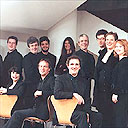
Composer Simon Holt has always had a close association with the Nash Ensemble. Their portrait concert of his music featured two outstanding performances of his ensemble works: Lilith, from 1990, and Canciones, written for the Nash in 1986.
Even in his instrumental pieces, Holt is a vivid dramatist, and his writing for the eight players in Lilith is full of violent gestures and contrasts. The piece is based on the myth of Adam's first wife, a mysterious serpent who bore him a host of unearthly offspring. The piece creates a soundworld that is at once seductive and disturbing, as terse knots of harmony unravel in sinewy, slippery lines, from a creeping bass clarinet to a hyperactive violin solo. The nocturnal hush of the final section was shattered by the shriek of an E flat clarinet; conductor Diego Masson and the Nash players paced this mysterious drama with conviction.
Images of shadow and night dominate the three Canciones for mezzo-soprano, here Jean Rigby, and nine players. Holt describes the first number, Eyes, to the Shadow, as a love song, but there was nothing sentimental about his setting. Instead, there was a desperate intensity in the repetition of a nagging, three-note refrain; this was love that had turned into obsession.
The central Song of the Rider was a nightmarish evocation of a ghostly horse and its dead rider. A furious viola solo, brilliantly played by Lawrence Power, launched the music on its ghoulish journey, which encompassed incisive woodwind writing and a volatile vocal line. Still more effective was the last song, Death in the Rose-bush, in which Rigby's vocal line was imprisoned by a briar of string sound, a deft realisation of the poem's imagery.
There was equally concentrated drama in a new work by Larry Goves, I Wear You on My Sleeve, for piano and string quartet. This three-movement work created a forceful poetry from the technical differences between the strings and the piano. Clusters and chords in the piano melted into a microtonal mist of string sound, before the music coalesced in another burst of pianistic colour. The last movement ended with an unexpected and passionate cello solo, compellingly played by Paul Watkins: music thattranscended the previous movements.
