
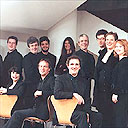
A few great composers - Verdi most famously, Messiaen and Stravinsky too - continued to produce masterpieces well into their 80s, but Elliott Carter is outstripping them all. Carter will be 95 in December and shows no signs of flagging creativity. Quite the opposite, in fact: new works may have come with painful slowness in his 50s and 60s, but the music now flows. There are major orchestral premieres in Boston and Chicago in the next two months, other works in the pipeline, and the Nash Ensemble's early birthday tribute on Tuesday included the British premiere of his Oboe Quartet, completed in 2001.
Like Carter's earlier Oboe Concerto, the Quartet was originally written for Heinz Holliger, but its world is much closer to pieces like the later quartets and the Triple Duo than to the composer's orchestral music. It is built out of a chain of six duos, using each possible pairing of the four instruments in turn; in each of them the other two members of the quartet supply comment and punctuation. The music is typically seamless and airy as the oboe skips and trills over the strings' filigree; nothing in the invention or the form seems forced or contrived.
The Nash placed the new piece in the context of old and not so old Carter chamber works. There was the Cello Sonata to begin, the score with which, in 1948, Carter demonstrated that he was not yet another American neoclassicist, but a true original. There were three of the miniatures - duets for flute and clarinet and flute and cello as well as a solo cello piece - that are studded through his later output, like monochrome studies for the bigger, more intricate musical canvases. There was a song cycle, too - Tempo e Tempi, from 1999, eight settings of early 20th-century Italian poets for soprano and an instrumental quartet. The works are superbly economical in the way they allow the voice to soar over the meshing clockworks of the accompaniments.
Valdine Anderson was the totally assured singer, Gareth Hulse the oboist, while Paul Watkins, with his brother Huw as pianist, gave what was simply the best performance of the Cello Sonata I've ever heard in a concert.
