
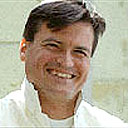
Christian Thielemann's latest concert with the Philharmonia carried with it intimations of being self-consciously image-breaking. The programme juxtaposed Debussy with Strauss, which is logical in some respects, for the two composers were more or less contemporaries who redefined the potential of both harmony and sonority.
In other respects, however, Debussy's presence represented a drastic point of departure for Thielemann, who has hitherto established himself as the controversial high priest of Austro-German Romanticism, rarely straying beyond its bounds.
Even so, his performances of L'Après Midi d'un Faune and La Mer were characterised by a sense of his venturing into foreign territory with a certain amount of tentativeness. He has not, as yet, quite got the feel for the inner pulse of Debussy's music. Phrases seem exaggeratedly linked rather than flowing organically into one another.
L'Après Midi d'un Faune, taken with magisterial slowness, had heavy, oppressive glitter, suggesting Jugendstil stasis rather than symbolist languor. La Mer, meanwhile, was heavy handed, the final movement not so much the "dialogue between the wind and the sea" of the Debussy title as a pitched battle, as Thielemann aggressively launched an almighty tempest that obscures the moments of concord and playfulness between the elements.
Turning to Strauss, Thielemann seemed more relaxed. The Four Last Songs were a late substitute in the programme for an earlier group of orchestral songs to have been performed by Anne Sofie von Otter.
Von Otter's withdrawal provided an opportunity, however, for us to hear the impressive Canadian soprano Adrianne Pieczonka in Strauss's final, valedictory masterpiece. Pieczonka's tone, incisive and grainy, may not be to everyone's taste, but she has a remarkable ability to project every flicker of meaning in the text, which is infinitely preferable to the wordless warbling you usually hear in this music.
Thielemann's approach, meanwhile, was unusually urgent: the thought of mortality, though eventually accepted, also brought with it telling moments of disquiet. He closed with a performance of Till Eulenspiegel that was second to none in swagger, bleakness and malign, sleazy wit and played with staggering virtuosity by the Philharmonia. Thielemann remains a great Straussian. Time will tell whether his Debussy improves.
