
There are some who, strangely, still refuse to take Verdi's Il Trovatore seriously. The most frequently voiced criticism of the opera is that it places some of the most thrilling music ever written at the service of a ramshackle, preposterous libretto. That is unfair - though the text does have its curious features.
The subject matter - the self-perpetuating nature of violence, the blighting consequences of parental madness upon children - is perhaps more relevant now than ever. The work's dramaturgy, however, is strange and unique. Most of the action takes place off stage. Verdi presents us with a sequence of arias and ensembles that convey heated emotional responses to appalling events we never actually witness. It is as if a savage Jacobean tragedy had been rewritten along the reined-in lines of Racine.
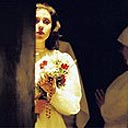
This austere, almost classical quality is to the fore in Peter Watson's production, first performed by Scottish Opera and now entering Welsh National Opera's repertory. Watson aspires to stasis, even abstraction. Metal walls, the colour of dried blood, imprison the characters. The costumes are neutral, mostly suggesting the 15th century in which the work is set, although Leonora, dreamer that she is, first appears in Jugendstil spangles, and Di Luna, the tortured tyrant, wears a Napoleonic greatcoat.
Such an approach, however, calls for great singing actors capable of pulling it off - and it is here that WNO occasionally slips up. Yuri Nechaev's Di Luna is monochrome and unremittingly loud. As Leonora, Elena Lasovskaya reveals a sumptuous, carnal tone, but her intonation above the stave is too wayward for comfort.
David Rendall's Manrico and Patricia Bardon's Azucena are infinitely finer. Rendall's combination of unforced lyricism and high-flying vocal athleticism is all the more remarkable given that he has recently been singing such taxing roles as Verdi's Otello and Wagner's Tristan.
The great performance, however, comes from Bardon. She looks a fraction too young, but her vocal and dramatic intensity is mesmeric. Her angular body movements and flashing eyes convey incipient derangement, and her final exultation at the havoc she has wrought is both disgusting and overwhelming. The conductor, the Spanish-born, Swedishbased Alberto Hold-Garrido, is all fire and steel, propelling Verdi's churning arpeggios and throbbing rhythms with a raw, nervous urgency.
· Until October 17. Box office: 029-2087 8889. Then touring.
