
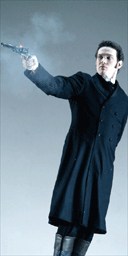
For his first new production as Welsh National Opera's music director, Tugan Sokhiev, has stayed with the repertoire he knows best. He conducted the Kirov Opera's production of Eugene Onegin when he made his debut at the Met in New York last summer, and here in Cardiff it is Onegin, too, this time in a staging by James Macdonald. Musically, the results are first-rate. The WNO orchestra responds to Sokhiev with playing of wonderful immediacy, the textures often raw-boned, the colours vivid. There are one or two moments when the drama could be pushed forward more, but generally the pacing is true and authentically operatic.
It provides the best possible support for a cast (including some reinforcements from the Kirov) whose every member is much more than adequate, and will surely become more dramatically convincing as the run continues. Amanda Roocroft's Tatyana never quite pins down the youthful impulsiveness of the opening act, and is more convincing as the grande dame of the last. And Vladimir Moroz's Onegin is a bit of a cold fish, whose ardent transformation for the final scene is hard to credit. Marius Brenciu's Lensky sings touchingly enough, and the older generation - Suzanne Murphy as Madame Larina, Linda Ormiston's Filipyevna and especially Brindley Sherratt's Gremin - are very carefully observed.
For all its straightforward truthfulness, though, the production seems underpowered. Macdonald's previous work for WNO was a Rigoletto that updated the action to the US in the 1960s, fixing it in JFK's White House, but his take on Onegin is traditional: we see more or less the worlds that Pushkin imagined. Tobias Hoheisel's set is mobile enough to conjure up the grandeur of St Petersburg as convincingly as the bucolic respectability of the Larins' estate, though for an opera in which dance plays a significant part, the positioning of a substantial flat halfway downstage hardly makes the choreographer's task easier.
Detail is understated, though sometimes telling. Tatyana is first glimpsed with her head in a book, and there are piles of books around the Gremins' apartment in the final scene, suggesting that her romantic idealism has not entirely been obliterated by her marriage. There, Macdonald also has Onegin brandish Tatyana's letter at the moment she is rejecting him; in Pushkin's original, Onegin keeps the letter after he rejects her, although Tchaikovsky's text omits that detail.
It is intended to give the screw another turn, but in the end you do not care about these characters enough. One of the most upsetting operas in the repertoire comes across as a comedy of manners rather than something more tragic.
· Repeated on Thursday and on February 24. Box office: 029-2087 8889. Then touring.
