
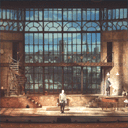
Twelve years late, Joan Guinjoan's Gaudí has finally reached the stage. Conceived to tie in with the Barcelona Olympics, it has survived the death of its librettist, Josep Maria Carandell, and the burning down and rebuilding of Barcelona's opera house. Not many cities feel the need to glorify their architects in this way, but when you consider the place Antonio Gaudí occupies in the Catalan consciousness the project's endurance seems less surprising. Foster: The Opera doesn't have the same ring.
However, obsessive recluses don't make for easy operatic subjects. Guinjoan and Carandell have dealt with this in two ways, and if the result creaks under the weight of its own worthiness, it does at least have the courage of its convictions.
First, those around Gaudí are combined into a handful of archetypes, with Guinjoan's thickly woven score, melodically driven yet rarely obvious, capturing the friendly pomposity of the patron Alexandre and the reactionary soppiness of Rosa.
Then they have drawn parallels between the social fissures opening up in Barcelona around the turn of the last century and the aesthetic upheavals that Gaudí struggled with. Beauty develops from, or in spite of, fragmentation; a full-scale ballet episode attempts, obscurely, to explore this, against diverging backdrops of Gaudí-esque mosaics.
The Liceu has pulled the stops out, with generous choral, balletic and orchestral forces and a spectacular set by Lluís Danes to distract from Manuel Huerga's static direction. There are two outstanding contributions: from conductor Josep Pons, who builds an ongoing musical momentum in the orchestra, and American baritone Robert Bork, bringing absolute commitment to the title role. With a libretto so full of platitudes, though, he has no option but to grab the words by the neck and shake them. Ultimately, Gaudí the opera doesn't come off. But if it can't be made to work here, it's impossible to imagine it doing so anywhere else.
· Until Sunday. Box office: 00 34 93 485 99 13.
