
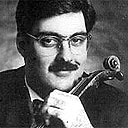
George Enescu's Third Violin Sonata is one of the weirdest works of early 20th century chamber music. The piece sounds as if it is derived from east-European folk tunes, yet every note of its three movements is Enescu's own: the composer's idealised vision of the folk culture of his native Romania. At Wigmore Hall, violinist Leonidas Kavakos made a compelling case for this unique, ambitious work, and revealed himself to be a brilliantly insightful chamber musician.
The first movement was a dream-like outpouring of free-form folk melodies, heightened by the exotic tunings and techniques of Enescu's violin writing, and Kavakos wove a web of florid ornamentation over Denes Varjon's piano playing. The second movement was stranger still. It began with a musical morse code in the piano part - the haunting chime of a single pitch in the instrument's highest register - over which Kavakos cast an ethereal spell, with a melody composed entirely of whistle-like harmonics. A shadowy tune slowly emerged from this musical limbo and grew into a dense, rumbling climax.
The music's sense of reverie was shattered by the third movement, a dance of dazzling complexity that was built from a simple melodic fragment. Kavakos dealt imperiously with the barrage of technical challenges Enescu throws at the violinist, before a final section in which he and Varjon created a texture of thrilling orchestral intensity.
There were more folk-inspired fireworks in Bartok's First Rhapsody, but the strength of Kavakos's and Varjon's partnership was revealed in sonatas by Bach and Schumann. The musicians conjured a transparent soundworld for Bach's E major Sonata, especially in the aching lyricism of the slow movement. Their performance of Schumann's D minor Sonata was even more illuminating: the first movement was an essay in dark, lyrical drama and the finale was an energetic musical chase, in which Kavakos and Varjon raced each other around the twists and turns of Schumann's tortuous counterpoint.
