
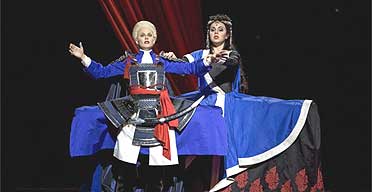
Mitridate is generally regarded as the finest of Mozart's early operas. It was commissioned by Milan's Regio Ducal Theatre in 1770, when the composer was only 14, and its oddly pre-Freudian subject now strikes us as astonishingly advanced for one so young.
Two doppelganger-ish brothers, Sifare and Farnace, the former noble, the latter devious, are involved in a bitter feud over Aspasia, whom they both love and whom their father, Mitridate, intends to make their new stepmother. The score advances the action in vast swathes of recitative interspersed with arias of vertiginous difficulty that equate emotional crisis with vocal athletics. For years, it was considered well-nigh unsingable, though in the past few decades, a generation of artists have emerged who are able to meet its challenges.
The Royal Opera's latest revival, scrupulously conducted by Richard Hickox, is chiefly notable for the performances by Sally Matthews and Aleksandra Kurzak as Sifare and Aspasia respectively. Matthews, always a fine singer and now a potentially great one, combines warmth of tone with impeccable technique. The diminutive Kurzak, meanwhile, making her house debut, delivers coloratura of such astonishing accuracy that you sit there open-mouthed.
Elsewhere, there are strengths and weaknesses. As Mitridate, Bruce Ford is now vocally past his best, though his ability to shape the music over such a vast range continues to impress. The Farnace, David Daniels, sounds gorgeous, but isn't nearly fierce enough.
Graham Vick's production, however, has lost some of its force. Considered a milestone in the staging of 18th-century opera when it was first seen in 1991, it overlays Baroque drama with elements drawn from traditional Indian and Japanese theatre. Extremely stylised, it needs a combination of incredible precision and conviction if it is to work. On this occasion, some of the singers seem ill at ease with it, and its impact is regrettably diminished.
· Until July 17. Box office: 020-7304 4000.
