
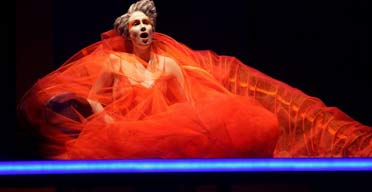
Next year Monteverdi's Orfeo will be 400 years old, yet the power of this first operatic masterpiece remains undiminished. In a good performance, its perfect fusion of words, music and drama seems to render the subsequent four centuries of operatic history redundant; if English National Opera's new staging does not quite manage that, in a work whose raison d'etre is a celebration of the power of music, it does assert the enduring qualities of Monteverdi's score, while ensuring that the visuals never overwhelm its instrumental and vocal beauties.
This Orfeo, a co-production with the Handel and Haydn Society of Boston, marks the British opera debut of the American-based Chinese director Chen Shi-Zheng. Working with designers Tom Pye (sets) and Elizabeth Caitlin Ward (costumes), Chen's staging introduces oriental elements into what is rooted in western ritual. Stage trappings are minimal and it is the 11 members of the Orange Island Dance Company, the Javanese troupe founded by Chen, who supply that exotic element, creating a tapestry of filigree movement around the dramatic core.
It's a curious fusion, more or less cosmetic and not always convincing, but one that creates some beguiling stage pictures. There are moments when it becomes intrusive - it's distracting, for instance, to have the dancers setting lanterns around the stage in the third act while Orfeo is singing his pivotal aria, Possente Spirto ("Almighty Spirit" in Christopher Cowell's new translation), and also undercuts Monteverdi's genius in empowering these mythic archetypes with real humanity. Yet, usually, there's something tactful about it too - an instinctive feeling of when the stage should be kept empty, and the singers and their music allowed the space for themselves.
Naturally, it's the tenor John Mark Ainsley in the title role who gets such opportunities most often, not only offering a masterclass in how to deliver this music with total clarity and direct emotional impact but also managing to match his own movements to the physicality of the dancers around him.
If he dominates the show musically, then both Elizabeth Watts as the allegorical Music and Hope and Wendy Dawn Thompson as the Messenger seize their moments too, while Tom Randle's appearances as the First Shepherd and as Apollo in the final scene to winch Orfeo up to heaven, are perfectly conceived cameos, even if they sometimes seem to belong in another production altogether. The period-instrumental playing from the combined forces of the ENO band and the Orchestra of the Age of Enlightenment seems a model of its kind; in the end, it's Monteverdi's music that lingers in the mind, as it should be.
· In rep until April 28. Box office: 0870 145 0200.
